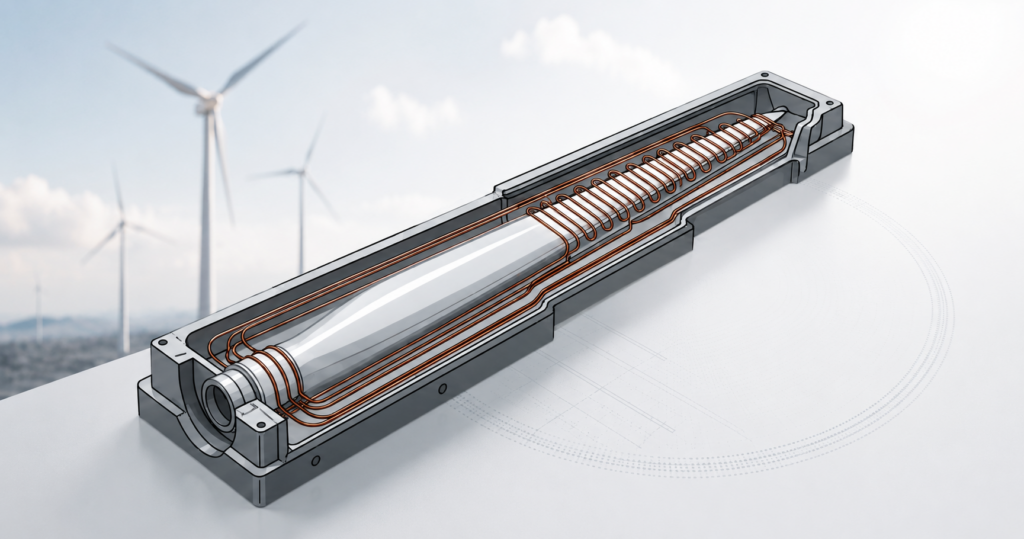
Resistance wire plays a critical role in wind turbine blade mold heating by delivering precise and uniform temperatures during composite curing. Proper wire design helps manufacturers improve product consistency, reduce cycle times, and increase energy efficiency throughout the blade production process.
As wind turbine blades continue to grow in size, manufacturers face increasing challenges in maintaining consistent temperatures across large composite molds. Reliable industrial heating solutions are essential for producing high-quality blades while controlling costs and maximizing throughput.
The Manufacturing Challenge: Heating Massive Composite Molds
Modern wind turbine blades can exceed 100 meters in length.
Producing these structures requires:
- Large composite molds
- Consistent curing temperatures
- Tight process control
- Reliable thermal management
Uneven heating can create:
- Inconsistent curing
- Structural defects
- Delamination issues
- Increased scrap rates
For manufacturers, maintaining temperature uniformity is one of the most critical factors in blade quality.
Why Temperature Control Matters in Composite Manufacturing
Composite materials require controlled heating throughout the curing process.
Temperature fluctuations can affect:
- Resin flow
- Cure consistency
- Mechanical properties
- Production timelines
Resistance heating systems help create the stable thermal environment needed for successful curing.
How Resistance Wire Supports Mold Heating
Resistance wire generates heat when electrical current passes through it. When integrated into mold heating systems, the wire provides:
- Uniform heat distribution
- Precise temperature control
- Repeatable manufacturing conditions
This allows manufacturers to maintain consistent temperatures across large mold surfaces.
Looking for custom industrial heating solutions for composite manufacturing? Pelican Wire can help develop resistance wire configurations tailored to demanding thermal applications.
Thermal Requirements for Wind Turbine Blade Production
Wind turbine blade molds present unique challenges:
Large Heating Areas
Heat must be distributed evenly across extensive mold surfaces.
Long Production Cycles
Heating systems may operate continuously for extended periods.
Consistent Temperature Profiles
Even small variations can impact blade quality.
High Reliability Requirements
Downtime can disrupt production schedules and increase costs.
Resistance wire systems help address these challenges through controlled and repeatable heat generation.
Key Resistance Wire Specifications for Mold Heating
Choosing the correct wire specification is critical. Important considerations include:
Resistance Characteristics
The wire must provide the correct heat output for the application.
Temperature Capability
Wire must withstand continuous operation throughout the curing cycle.
Mechanical Durability
Industrial environments require robust wire designs.
Uniform Heat Distribution
Proper wire layout ensures consistent mold temperatures.
At Pelican Wire, wire solutions can be customized to meet specific thermal requirements.
Common Resistance Wire Materials
Several materials are commonly used in industrial heating applications.
Nichrome Wire
Popular for:
- Stable resistance
- Long service life
- Reliable heat generation
Specialized Resistance Alloys
Used when applications require specific thermal or environmental performance characteristics. The optimal material depends on:
- Operating temperature
- Production cycle requirements
- Environmental conditions
Improving Manufacturing Efficiency Through Better Heating Design
Well-designed mold heating systems can deliver significant benefits.
Faster Cure Cycles
Consistent heat can reduce overall processing time.
Reduced Energy Consumption
Efficient heat distribution minimizes waste.
Improved Product Quality
Uniform temperatures reduce defects.
Increased Throughput
Reliable systems support higher production volumes.
Need help designing resistance wire systems for large-scale composite manufacturing? Pelican Wire’s engineering team can help identify wire solutions optimized for performance and efficiency.
Best Practices for Resistance Wire Mold Heating
Manufacturers can improve results by:
- Designing for uniform heat distribution
- Selecting wire rated for continuous operation
- Monitoring temperatures throughout curing
- Regularly inspecting heating elements
- Using custom-engineered wire configurations
These practices help maximize both quality and efficiency.
FAQs: Wind Turbine Heating Wire
What is wind turbine blade mold heating?
Wind turbine blade mold heating is the process of applying controlled heat to composite molds during blade manufacturing. The heat helps cure the resin and composite materials properly, ensuring the finished blade achieves the required strength, durability, and structural integrity. Consistent mold temperatures are critical for producing high-quality blades and minimizing manufacturing defects.
Why is resistance wire used in composite mold heating?
Resistance wire is used because it provides precise and uniform heat across large mold surfaces. As electricity passes through the wire, it generates controlled heat that can be distributed evenly throughout the mold. This helps maintain consistent curing conditions, which is essential for achieving reliable composite performance and product quality.
What are the benefits of mold heating?
Proper mold heating helps improve composite curing consistency, leading to better product quality and fewer manufacturing defects. It can also reduce curing times, improve energy efficiency, and increase production throughput by creating a more controlled and repeatable manufacturing process.
Is nichrome wire used in composite manufacturing?
Yes. Nichrome wire is commonly used in composite mold heating systems because it offers stable electrical resistance, reliable heat generation, and excellent durability under repeated heating cycles. Its ability to maintain consistent performance over time makes it a popular choice for industrial heating applications.
Can Pelican Wire provide custom heating wire solutions?
Yes. Pelican Wire offers custom resistance wire solutions for industrial heating applications, including composite manufacturing and mold heating systems. Our team can help develop wire configurations tailored to specific temperature requirements, mold designs, and production environments to support efficient and reliable heating performance.
Supporting Advanced Composite Manufacturing with Reliable Heating Solutions
As wind turbine blades continue to increase in size and complexity, manufacturers need heating systems that deliver precise and repeatable performance. Proper resistance wire design supports consistent curing, improved product quality, and more efficient production processes.
At Pelican Wire, we provide custom resistance wire solutions that help manufacturers meet demanding thermal requirements and optimize composite manufacturing operations.