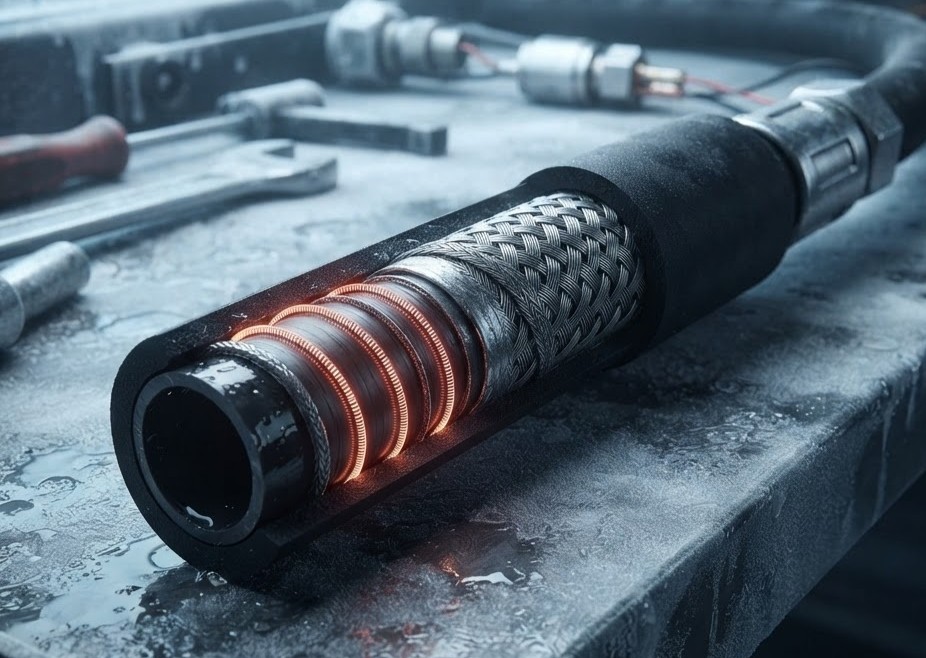
A fluid line can look like a simple component until temperature becomes part of the design requirement. In automotive, mobile equipment, industrial dispensing and process systems, the fluid moving through a hose or tube may have to remain within a specific temperature range to flow, meter or react correctly. When ambient conditions fall, the line itself can become a thermal-management problem.
That is where resistance heating wire becomes part of the system rather than simply another component inside it.
At Pelican Wire, we engineer resistance wire for applications in which heat has to be produced predictably, delivered in a compact space and maintained through real operating conditions. Heated fluid transfer systems are a good example because electrical performance, mechanical durability, insulation chemistry, dimensional limits and manufacturing repeatability all have to work together.
Why Heated Fluid Lines Need Engineered Heat
Temperature changes can alter viscosity, flow rate, pressure drop and the ability of a fluid to move through a delivery system. In some applications, the fluid can freeze. Diesel Exhaust Fluid (DEF), for example, is a 32.5% urea solution in deionized water and begins to freeze at about 12°F (-11°C). Modern selective catalytic reduction systems are designed to thaw the DEF tank and supply lines after startup so that the fluid can be delivered to the aftertreatment system.
Other applications have different thermal challenges. Adhesives and sealants may become too viscous to meter correctly. Foams and coatings may require a controlled delivery temperature for consistent application. Water-bearing process fluids may need freeze protection. In each case, the engineering question is similar:
How do you put the right amount of heat in the right place without making the line too large, too stiff or too difficult to manufacture?
The answer begins with the heating element.
Start With the Electrical Requirement
Resistance wire converts electrical energy into heat through Joule heating. The basic relationship is straightforward:
P = I²R
But designing an effective heated line is not as simple as selecting a wire that “gets hot.” Engineers normally have to work backward from the system requirements.
What voltage is available? How long is the heated section? What wattage is needed per foot or per zone? What is the maximum conductor temperature? How quickly must the system warm? Is the line heated continuously, intermittently or only during a cold-start event?
Those questions establish the resistance target for the heating element. The wire alloy, diameter, strand construction and total length can then be engineered to deliver the required ohms per foot and total resistance.
For high-volume assemblies, tolerance matters just as much as the nominal value. If resistance varies significantly from one production lot to another, heat output can vary with it. Pelican Wire specializes in precision resistance constructions and can engineer tighter resistance tolerances when the application requires greater consistency.
Flexibility Is a Design Variable, Not an Afterthought
A heated hose on a moving vehicle is not a stationary heating element.
It may be routed around tanks, pumps, frame members and connectors. It may see vibration throughout its service life. During assembly, it may be bent, wrapped, pulled or formed into a specific path. In some systems, portions of the hose move during operation.
That mechanical environment influences the conductor design.
A solid resistance conductor may work well in a fixed geometry, while a stranded construction can provide greater flexibility and improved resistance to repeated bending. Other designs may use a resistance alloy served around a core to combine heating performance with a highly flexible structure.
The important point is that electrical resistance and mechanical behavior cannot be specified independently. Changing the strand count, wire diameter or lay can affect both flexibility and electrical performance. A custom design allows those variables to be balanced around the actual application.
Insulation Has More Than One Job
The insulation around a heating conductor has to protect the electrical circuit, but in a fluid-transfer system it may also have to survive heat, vibration, abrasion, moisture, automotive chemicals and tight dimensional constraints.
Pelican Wire works with a broad range of insulation materials, including fluoropolymers such as FEP, ETFE, PFA and other engineered compounds. The best choice depends on the environment.
Key questions include:
- What continuous and short-term temperatures will the wire see?
- Will the wire be exposed to DEF, fuel, oil, coolant, cleaning agents or other chemicals?
- How much abrasion can occur during assembly or service?
- Is a low-friction surface helpful for integrating the wire into a hose?
- What voltage rating and insulation thickness are required?
- How tightly does the finished diameter need to be controlled?
Selecting insulation only by temperature rating can miss the real failure mode. A material may tolerate the heat but lack the flex, abrasion or chemical characteristics required by the assembly. The correct insulation is part of the complete electromechanical design.
Uniform Heat Matters
A fluid line usually needs controlled heat along a defined length, not isolated hot spots.
That makes dimensional consistency and resistance consistency especially important. The heating element must be integrated so that heat is distributed through the hose or tube in a predictable way. Depending on the design, the wire may run longitudinally, spiral around the fluid path or be incorporated into a larger textile, braided or jacketed construction.
The pitch of a spiral, the thermal conductivity of surrounding materials, the distance between the resistance element and the fluid, and the location of sensors or controls can all affect the temperature profile.
This is why a heating-wire supplier should be involved before the hose construction is frozen. Small changes in wire diameter, resistance or flexibility can make the complete assembly easier to route, manufacture and control.
Automotive Fluid Heating: Small Wire, Big Responsibility
Automotive and heavy-duty vehicle systems create a demanding combination of cold-weather performance, vibration, space limitations and production repeatability.
DEF systems are one visible example. Because DEF can freeze at approximately 12°F (-11°C), SCR systems incorporate strategies to thaw the fluid and restore delivery. Heated lines and tanks are part of that cold-weather system design. The heating element has to operate within a packaging envelope that is already crowded with fluid tubing, fittings, electrical connections, shielding and protective coverings.
Other automotive fluid applications may include washer systems, fuel or fuel-additive systems, battery thermal-management loops, sensor or sampling lines and other temperature-sensitive delivery paths.
The common need is not simply “hot wire.” It is a wire engineered to a resistance target, built with the appropriate insulation, compatible with the assembly process and repeatable enough for production.
Have You Reviewed our PRODUCT DESIGN TOOLS???
Five Questions to Answer Before Specifying Heating Wire
A productive design conversation usually begins with five groups of requirements.
1. Electrical: available voltage, target wattage, total length, resistance target and acceptable tolerance.
2. Thermal: ambient range, desired fluid or line temperature, warm-up time, duty cycle and maximum allowable conductor temperature.
3. Mechanical: bend radius, vibration, flexing, tensile load, routing constraints and finished diameter.
4. Environmental: fluids and chemicals present, moisture, abrasion, UV exposure and any cleaning or sterilization requirements.
5. Manufacturing: how the wire will be wound, braided, taped, extruded, jacketed, terminated or incorporated into the final assembly.
The earlier those variables are considered together, the easier it is to avoid a design that works electrically but creates problems somewhere else in the system.
Where Custom Engineering Creates Value
Off-the-shelf resistance wire is useful when the application can adapt to the wire. Custom resistance wire becomes valuable when the wire has to adapt to the application.
Pelican Wire can engineer conductor alloy, gauge, strand configuration, resistance per unit length, insulation system, finished diameter and other construction details around the needs of the assembly. Our custom capabilities include precision stranding, extrusion, taping, textile and metal serves, overbraiding and specialized constructions for challenging thermal and mechanical environments.
That flexibility is particularly useful during prototype and design-validation stages. Instead of forcing a hose or fluid system around a standard wire, engineers can work toward a heating element that supports the electrical, thermal and mechanical targets from the beginning.
Build the Heat Into the System
The best heated fluid line is not a hose with a heater added to it. It is a thermal system in which the heating element, fluid path, insulation, controls and mechanical construction have been designed to work together.
For engineers developing heated hoses, DEF delivery systems or other temperature-sensitive fluid-transfer assemblies, the resistance wire is a small part with a large influence on performance.
Pelican Wire has more than five decades of experience developing custom-engineered resistance wire for demanding applications. If your project requires a specific resistance, tight tolerance, fine gauge, flexible construction or specialized insulation, our team can help translate the application requirements into a manufacturable wire design.