Introduction: Why Material Selection Matters More Than Ever
When a heating element fails prematurely, the root cause is rarely the equipment surrounding it. More often, it traces back to a single decision made early in the design process: the choice of resistance wire.
As industrial processes push toward higher temperatures, tighter tolerances, and longer service life, the margin for error in material selection continues to shrink. A wire that performs flawlessly at 800°C may degrade rapidly at 1,000°C. An alloy that resists steady-state oxidation beautifully may crack under repeated thermal cycling. The difference between a component that lasts six months and one that lasts six years often comes down to matching the right alloy to the real-world demands of the application.
This guide is written for the engineers, product designers, and procurement specialists who make those decisions. We’ll examine how resistance heating works, break down the major high-temperature alloy families, and explore the properties that separate a good specification from a great one.
What Is High-Temperature Resistance Wire?
High-temperature resistance wire is a specialized conductor engineered to convert electrical energy into heat efficiently while withstanding sustained exposure to elevated temperatures—typically above 600°C (1,112°F) and, in the most demanding alloys, beyond 1,200°C (2,192°F).
Unlike standard conductive wire, which is optimized to carry current with minimal resistance, high-temperature resistance wire is designed for the opposite purpose. It has a controlled, relatively high electrical resistivity, allowing it to generate predictable heat when current flows through it. Just as importantly, it maintains structural and chemical stability at temperatures that would rapidly destroy ordinary metals.
These wires form the heart of countless applications: industrial furnaces, kilns, heat-treating equipment, aerospace components, medical sterilization devices, foodservice appliances, and specialized sensing and instrumentation systems.
How Resistance Heating Works
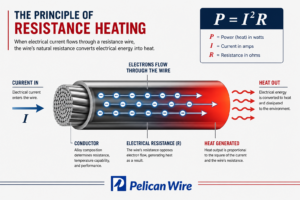
The physics behind resistance heating is elegantly simple, governed by Joule’s Law:
> **P = I²R**
> Power (heat) equals current squared multiplied by resistance.
When an electrical current passes through a material that resists the flow of electrons, that resistance converts electrical energy into thermal energy. The greater the resistance and the higher the current, the more heat the wire produces.
For engineers, the practical implications are significant. Selecting a wire means balancing several interdependent variables:
– Resistivity: determines how much heat the wire generates per unit length.
– Wire diameter (gauge): Affects both resistance and the wire’s ability to physically withstand its operating environment.
– Temperature coefficient of resistance (TCR): Describes how resistance changes as the wire heats up—a critical factor for consistent performance.
A well-designed heating element accounts for all three, ensuring the wire reaches its target temperature reliably without overheating, sagging, or burning out.
Understanding the Major High-Temperature Alloy Families
Most high-temperature resistance wires fall into two dominant categories, each with distinct strengths.
Nickel-Chromium (NiCr) Alloys
Nickel-chromium alloys—commonly known by trade names like Nichrome—are the workhorses of the resistance heating world. Typically composed of roughly 80% nickel and 20% chromium (or 60/16 variants with iron), these alloys offer:
– Excellent oxidation resistance up to approximately 1,150–1,200°C
– Good mechanical strength at elevated temperatures
– Smooth, stable resistance characteristics
– Strong resistance to thermal cycling fatigue
NiCr alloys are the go-to choice for applications requiring frequent on/off cycling, ductility for tight bends, and reliable long-term performance.
Iron-Chromium-Aluminum (FeCrAl) Alloys
Iron-chromium-aluminum alloys—sold under names such as Kanthal and, in Pelican Wire’s portfolio, alloys like 875 and 815—represent the high-temperature frontier. These alloys can operate at temperatures up to approximately 1,400°C, exceeding what most NiCr alloys can tolerate.
FeCrAl alloys achieve their exceptional performance through the formation of a protective aluminum-oxide layer. Their advantages include:
– Higher maximum operating temperatures
– Higher resistivity, allowing for more design flexibility
– Lower density and often lower cost than nickel-rich alloys
– Superior oxidation resistance at extreme temperatures
The trade-off: FeCrAl alloys are generally less ductile than NiCr, particularly after they’ve been heated and aged, which requires thoughtful handling and design.
| Property | NiCr (Nichrome) | FeCrAl (Iron-Chromium-Aluminum) |
|---|---|---|
| Maximum Continuous Operating Temperature | ~1,100–1,200°C | ~1,300–1,425°C |
| Electrical Resistivity | Higher (≈1.09–1.18 μΩ·m) | Moderate (≈1.35–1.50 μΩ·m depending on grade) |
| Density | ~8.2–8.5 g/cm³ | ~7.1–7.3 g/cm³ (about 15% lighter) |
| Ductility / Formability | Excellent; easy to coil and fabricate | Good, but more brittle after high-temperature exposure |
| Oxidation Resistance | Very good | Excellent (forms a highly protective aluminum oxide layer) |
| Typical Applications | Appliances, laboratory heaters, cartridge heaters, industrial heating elements | Industrial furnaces, kilns, heat treatment equipment, ceramic processing, high-temperature resistance heating |
The Science of Oxidation Resistance
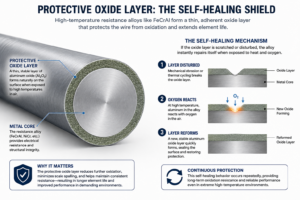
At high temperatures, metals react aggressively with oxygen. Left unchecked, this oxidation would rapidly consume a bare metal wire. High-temperature alloys survive by forming a stable, self-healing protective oxide layer that shields the underlying metal.
The chemistry differs by alloy family:
– **NiCr alloys** form a chromium-oxide (Cr₂O₃) layer. This scale is protective and adherent but becomes less stable at the very highest temperatures.
– **FeCrAl alloys** form an aluminum-oxide (Al₂O₃) layer. Alumina is exceptionally stable, dense, and slow-growing, which is precisely why FeCrAl alloys can operate at higher temperatures.
The critical concept here is that this oxide layer is both a shield and a consumable resource. Each time the wire heats and cools, the layer can crack, spall, and reform—consuming a small amount of the alloy’s aluminum or chromium reserve in the process. Once that reserve is depleted, the wire loses its protection and fails rapidly.
Maximum Operating Temperatures & Why They Aren’t the Whole Story
It’s tempting to select a wire based solely on its published maximum operating temperature. This is one of the most common—and costly—mistakes in specification.
A maximum operating temperature is a ceiling, not a recommendation. Published maximums typically assume ideal conditions: steady-state operation, clean atmospheres, and continuous use. Real-world applications rarely offer such courtesy.
Several factors reduce the practical usable temperature:
– Atmosphere. Reducing atmospheres, sulfur-bearing environments, or carbon-rich conditions can attack the protective oxide layer and dramatically shorten wire life.
– Wire diameter. Thinner wires have less material reserve to sustain their protective oxide, so fine-gauge wires often carry lower recommended operating temperatures than heavier gauges of the same alloy.
– Duty cycle. Continuous operation and cyclic operation age wire very differently.
– Mechanical load. At high temperatures, alloys lose strength and may sag or deform under their own weight or applied tension.
The lesson: treat maximum temperature as one input among many, and always design with an appropriate safety margin.
Thermal Cycling: The Hidden Cause of Premature Failure
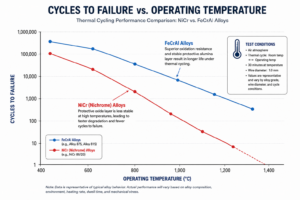
Steady-state operation is relatively kind to resistance wire. Thermal cycling, repeatedly heating and cooling the element is where many components meet an early end.
Each thermal cycle subjects the wire to expansion and contraction. Because the metal core and its protective oxide layer expand at different rates, cycling induces mechanical stress at the interface between them. Over many cycles, this stress causes the oxide to crack and flake away. The wire then consumes more of its aluminum or chromium reserve to rebuild the layer, accelerating depletion.
This is a key reason alloy selection can’t rely on temperature ratings alone. An FeCrAl alloy might boast a higher maximum temperature, but a NiCr alloy may deliver longer life in an application with frequent, aggressive cycling because of its superior ductility and cycling resistance.
Mechanical Properties That Engineers Often Overlook
Beyond electrical and oxidation performance, several mechanical properties quietly determine whether a wire succeeds in the field:
– Hot strength (creep resistance): The ability to resist deformation under load at temperature. Critical for suspended or horizontally mounted elements.
– Ductility and formability: How tightly the wire can be bent or coiled without cracking—both when new and after aging.
– Post-aging embrittlement: Some alloys, especially FeCrAl, become brittle after prolonged high-temperature exposure, making field repairs difficult.
– Coefficient of thermal expansion: Affects dimensional stability and stress on adjacent components.
Overlooking these properties can lead to elements that pass initial testing but fail during handling, installation, or long-term service.
Selecting the Right Resistance Wire for Your Application
Bringing it all together, a robust selection process considers the following, in roughly this order:
- Define the true operating temperature: Include peak transients, not just the nominal setpoint.
- Characterize the atmosphere: Oxidizing, reducing, sulfur-bearing, or vacuum.
- Determine the duty cycle: Continuous versus cyclic, and how aggressive the cycling is.
- Establish mechanical requirements: Load, mounting orientation, and forming needs.
- Calculate electrical parameters: Target power, voltage, resistance, and resulting wire length and gauge.
- Apply a safety margin: Appropriate to the criticality of the application.
- Validate with testing, under representative conditions.
CLICK HERE TO UTILIZE OUR PRODUCT DESIGN TOOLS
When Standard Alloys Aren’t Enough: The Value of Custom Engineering
Off-the-shelf alloys serve a vast range of applications well. But demanding, mission-critical designs often benefit from customization that standard products simply can’t deliver.
Custom engineering can address:
– Precise resistance tolerances for consistent, repeatable heating.
– Specialized insulation matched to temperature, chemical, and dielectric requirements.
– Custom gauges and constructions optimized for a specific element geometry.
– Application-specific coatings or claddings for unique environments.
This is where partnering with a manufacturer that both the metallurgy and the winding, coating, and processing of wire becomes invaluable. The alloy is only the starting point; how it’s engineered into a finished product determines real-world performance.
Alloy 875 and Alloy 815 in Context
Within the FeCrAl family, Alloys such as 875 and 815 occupy an important niche for high-temperature applications.
Alloy 875 is engineered for very high operating temperatures, offering excellent oxidation resistance through its robust alumina-forming chemistry. It’s well suited to applications where sustained high heat is the primary demand.
Alloy 815 provides a complementary set of characteristics, balancing high-temperature capability with specific resistivity and mechanical properties that suit a range of heating and industrial applications.
Both alloys illustrate the core theme of this guide: the “best” wire is always the one matched to the specific combination of temperature, atmosphere, cycling, and mechanical demands your application presents. For exact specifications, resistivity values, and temperature ratings, consult the detailed datasheets, as published figures should always be confirmed against your operating conditions.
Why Engineers Partner with Pelican Wire
Selecting and sourcing high-temperature resistance wire is rarely a catalog transaction. Pelican Wire brings decades of manufacturing expertise, deep material knowledge, and a consultative approach that helps engineers get the specification right the first time.
From standard NiCr and FeCrAl alloys to fully custom constructions with specialized insulation and tolerances, Pelican Wire partners with designers to translate performance requirements into reliable, manufacturable products—backed by responsive engineering support and consistent quality.
Have a challenging thermal application? Talk to a Pelican Wire engineer
Frequently Asked Questions
What is the difference between NiCr and FeCrAl resistance wire?
NiCr (nickel-chromium) alloys offer excellent ductility and thermal cycling resistance with operating temperatures up to roughly 1,150–1,200°C. FeCrAl (iron-chromium-aluminum) alloys reach higher maximum temperatures—up to approximately 1,400°C—and offer higher resistivity, but are generally less ductile, especially after aging.
How do I choose the right resistance wire for high temperatures?
Start by defining your true peak operating temperature, the atmosphere, and the duty cycle (continuous vs. cyclic). Then establish mechanical and electrical requirements, apply a safety margin, and validate with testing. Published maximum temperatures are ceilings, not recommended operating points.
Why does resistance wire fail prematurely?
The most common causes are exceeding practical operating temperatures, aggressive thermal cycling that depletes the protective oxide layer, incompatible atmospheres, and mechanical stress or sag at temperature. Depletion of the wire’s aluminum or chromium reserve ultimately leads to rapid oxidation and failure.
What is the maximum temperature for resistance heating wire?
It depends on the alloy. High-performance FeCrAl alloys can operate up to approximately 1,400°C, while typical NiCr alloys are rated up to around 1,150–1,200°C. Always confirm ratings against your specific wire gauge, atmosphere, and duty cycle.
Can resistance wire be custom-engineered?
Yes. Custom options include precise resistance tolerances, specialized insulation, custom gauges and constructions, and application-specific coatings—allowing the wire to be optimized for demanding or unique applications.
Conclusion: Get the Specification Right, the First Time
High-temperature resistance wire selection is a multivariable engineering problem, not a single-number lookup. Temperature ratings matter, but so do atmosphere, thermal cycling, mechanical loading, and the subtle metallurgy of the protective oxide layer that keeps a wire alive. Engineers who account for all of these factors—and who partner with a manufacturer that understands both the material and its processing—build components that last.
Whether you’re specifying a standard NiCr element or engineering a custom FeCrAl solution for an extreme environment, the right guidance makes the difference between a component that merely works and one that endures.
Ready to solve your high-temperature challenge? Connect with Pelican Wire’s engineering team for a consultation tailored to your application’s exact requirements.